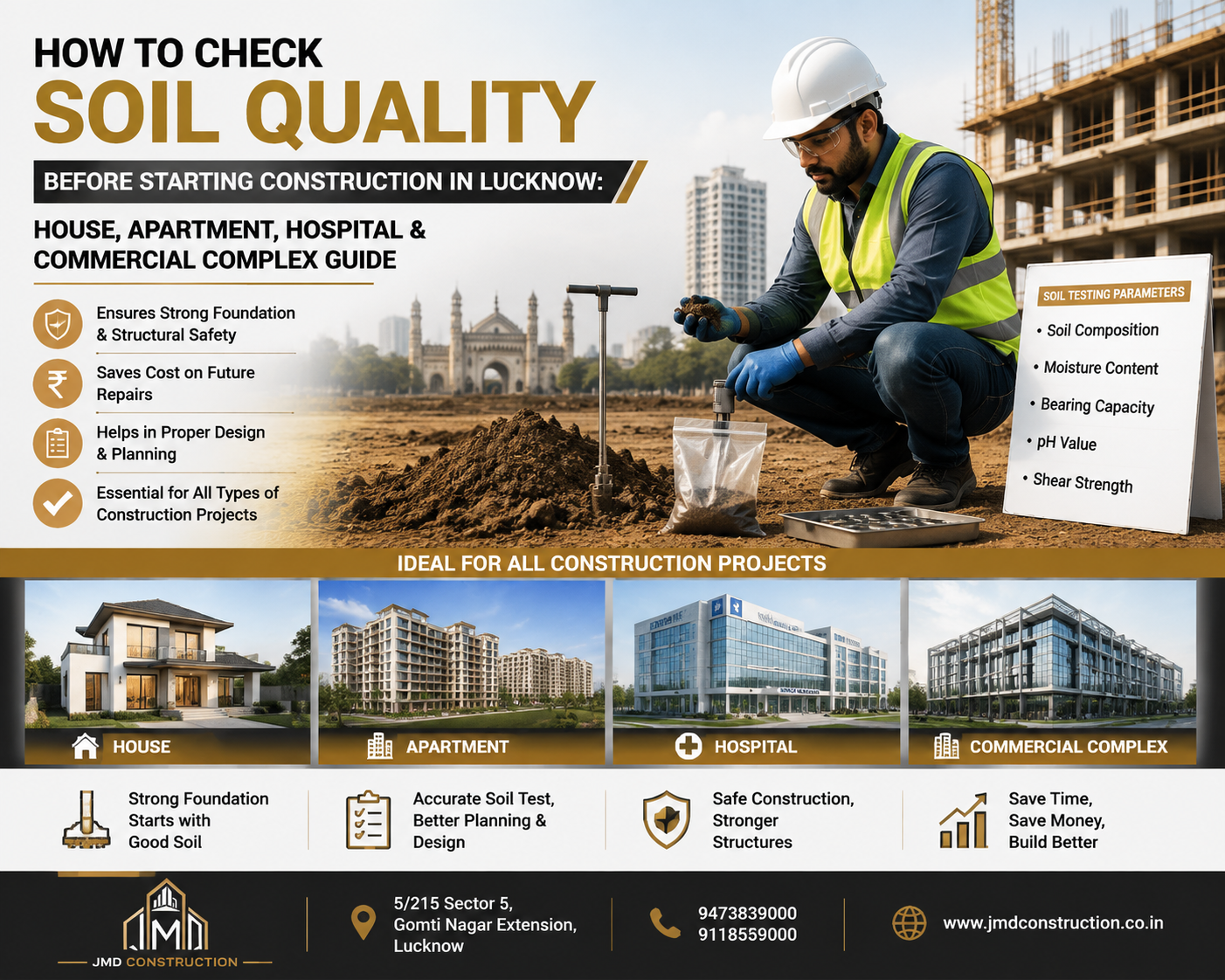
How to Check Soil Quality Before Starting Construction in Lucknow: House, Apartment, Hospital & Commercial Complex Guide
Building a house, residential apartment, hospital, or commercial complex is one of the largest financial investments you will ever make. While most property owners focus heavily on 3D front elevation designs, floor plans, and interior decor, the true strength of any structure lies beneath the ground—in the soil quality.
In Lucknow, soil characteristics vary significantly across different zones. Areas along the Gomti River belt (such as Gomti Nagar Extension and Shaheed Path) feature high alluvial sand content, while outer areas like Sultanpur Road and Sitapur Road may contain clay, silt, or loose topsoil.
Failing to test soil quality before laying the foundation can lead to structural cracks, uneven building settlement, foundation failure, or water seepage.
In this comprehensive guide, JMD Construction breaks down how to test soil quality, why soil testing is critical for complex structures like hospitals and multi-story apartments, and what it costs in Lucknow.
High-Intent Keywords Covered in This Guide
-
Soil testing for construction in Lucknow
-
How to check soil quality before building construction
-
Soil bearing capacity (SBC) report cost in Lucknow
-
Geotechnical investigation for hospital and apartment construction
-
Types of soil tests for commercial building foundation
1. Why Soil Testing is Mandatory Before Construction in Lucknow
Soil testing (also known as a Geotechnical Investigation) evaluates the chemical and physical properties of the land. It tells structural engineers how much weight the ground can safely support without sinking or shifting.
Key Reasons to Test Soil:
-
Determines Foundation Type: Tells your structural engineer whether your building needs a spread footing, raft foundation, or deep pile foundation.
-
Prevents Differential Settlement: Prevents one corner of your house or hospital from sinking faster than another, which causes major wall cracks.
-
Assesses Water Table Levels: High groundwater levels in low-lying zones of Lucknow require waterproofing and sub-soil drainage systems during foundation laying.
-
Ensures Chemical Safety: Identifies excessive sulfates or chlorides in subsoil that can corrode steel reinforcement bars (rebar) and weaken concrete structures over time.
2. Soil Quality Requirements by Building Type
The depth and intensity of soil testing depend directly on the structural load of your proposed building:
| Building Type | Structural Load | Recommended Soil Borehole Depth | Key Soil Testing Focus |
| Independent House / Villa (G+1 to G+2) | Low to Medium | 5 to 10 Meters (Minimum 1-2 Boreholes) | Safe Bearing Capacity (SBC), Topsoil Moisture Content, Direct Shear Test. |
| Residential Apartment Complex (G+3 & Above) | High | 15 to 30 Meters (Minimum 3-4 Boreholes) | Standard Penetration Test (SPT), Settlement Analysis, Liquefaction Susceptibility. |
| Hospital & Healthcare Facilities | Critical / Heavy Equipment Load | 20 to 35+ Meters (Grid Testing) | Dynamic Loading Capacity (for heavy MRI/CT scanners), Vibration Tolerance, Sulfate Content. |
| Commercial Complex & Warehouses | Heavy Point Loads | 15 to 25 Meters | Plate Load Test, Triaxial Compression Test, Soil Permeability. |
3. Top Soil Tests Conducted Before Construction
During a professional geotechnical field survey in Lucknow, civil engineers perform both field tests and laboratory tests:
A. Field Tests (On-Site)
-
Standard Penetration Test (SPT): Measures soil density and resistance by driving a split-spoon sampler into the ground using a standard hammer weight.
-
Plate Load Test: Evaluates the ultimate bearing capacity and probable settlement of soil under a loaded steel plate.
-
Cone Penetration Test (CPT): Determines soil strata continuous resistance without drilling boreholes.
B. Laboratory Tests (In Lab)
-
Grain Size Analysis (Sieve Analysis): Determines whether the soil is classified as sand, silt, or clay.
-
Atterberg Limits Test: Measures plastic and liquid limits of clayey soils to determine swelling and shrinkage risks.
-
Direct Shear & Triaxial Compression Test: Measures the shear strength parameters (Cohesion ‘C’ and Angle of Internal Friction ‘phi’) necessary to compute foundation design.
-
Chemical Analysis of Subsoil & Groundwater: Tests pH levels, sulfate, and chloride content to protect underground concrete structures.
4. How Much Does Soil Testing Cost in Lucknow?
The cost of a geotechnical soil testing report in Lucknow depends on the number of boreholes, depth requirements, and field accessibility.
-
Independent Residential Plots (G+1 / G+2 House): ₹8,000 to ₹18,000 (Basic report with 1-2 boreholes up to 6–10 meters depth).
-
Commercial Buildings & Apartment Projects (G+3 to G+7): ₹25,000 to ₹60,000 (Multi-borehole deep testing up to 15–20 meters).
-
Hospitals & Heavy Industrial Complexes: ₹60,000 to ₹1,500,000+ (Grid borehole drilling, deep pile load tests, dynamic vibration analysis).
5. How JMD Construction Ensures Structural Safety on Every Project
A soil test report is only useful if its Safe Bearing Capacity (SBC) values are correctly translated into structural engineering design.
At JMD Construction, we take zero shortcuts when it comes to foundation integrity:
-
Certified Geotechnical Audits: We conduct soil testing through certified laboratories across Lucknow for residential, commercial, hospital, and apartment projects.
-
Custom Foundation Engineering: Our in-house structural engineers design footings tailored specifically to the site’s soil profile (e.g., raft foundations for soft clay or pile foundations for deep loose strata).
-
Anti-Corrosion & Waterproofing Protocols: We use sulphate-resistant cement (SRC) and advanced damp-proofing membranes whenever soil chemical analysis indicates high water or mineral content.
-
LDA & Municipal Approval Compliance: Our soil reports meet all Lucknow Development Authority (LDA) structural safety guidelines for fast building plan approvals.
Build with Confidence – Partner with JMD Construction
Whether you are planning an independent luxury residence, a commercial shopping complex, a multi-story apartment, or a multi-specialty hospital in Lucknow, structural safety starts below ground level.
Trust JMD Construction for turnkey construction solutions—from architectural design and soil testing to solid civil execution and premium finishing.
-
Office Address: 5/215 Sector 5, Gomti Nagar Extension, Lucknow, Uttar Pradesh 226010
-
Phone Numbers: +91-9473839000 / +91-9118559000
-
Website: www.jmdconstruction.co.in

how to check soil quality before construction