Red Bricks vs AAC Blocks: Which Is Best for Construction in Lucknow?
Red bricks vs AAC blocks is one of the most common questions homeowners ask before starting a new house. The choice of wall material can affect construction speed, wall weight, insulation, plastering, material handling and overall project cost.
For people planning house construction in Lucknow, both traditional red clay bricks and AAC (Autoclaved Aerated Concrete) blocks can be suitable. However, the better option depends on the building design, structural system, availability, workmanship and project requirements.
AAC blocks are covered by IS 2185 (Part 3), which includes requirements relating to dimensions, density, compressive strength, thermal conductivity and drying shrinkage.
In this guide, JMD Construction compares AAC blocks vs red bricks for house construction in Lucknow and explains which factors homeowners should consider before making a decision.
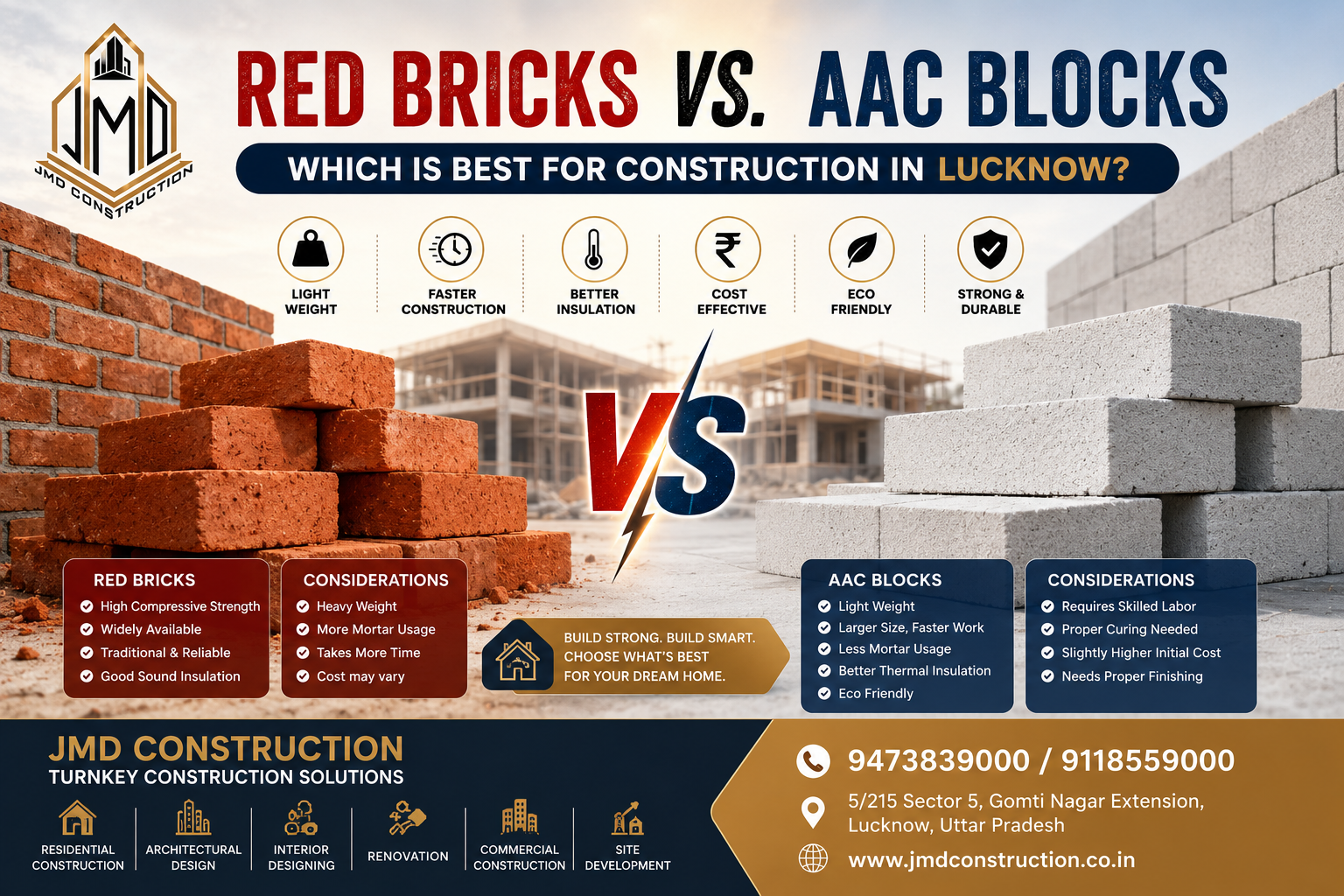
Red Bricks vs AAC Blocks: Quick Comparison
| Feature | Red Bricks | AAC Blocks |
|---|---|---|
| Weight | Heavier | Much lighter |
| Wall construction | Traditional | Faster with larger blocks |
| Thermal insulation | Moderate | Generally better |
| Handling | More labour-intensive | Easier to handle |
| Mortar requirement | Generally higher | Generally lower with suitable systems |
| Surface finish | Traditional | Usually more uniform |
| Availability | Widely available | Availability depends on supplier |
| Moisture management | Requires proper detailing | Requires proper detailing |
| Best suited for | Traditional construction | Lightweight modern construction |
Important: Actual performance depends on the specific product, grade, workmanship and design. Don’t choose a block solely from a generic comparison table.
What Are Red Bricks?
Red bricks are traditional masonry units made primarily from clay and hardened through firing.
They have been used for residential construction in India for generations and remain widely available in Lucknow and Uttar Pradesh.
Advantages of Red Bricks
- Familiar to local masons
- Widely available
- Easy to source
- Proven traditional construction method
- Suitable for many residential applications
- Individual damaged bricks can generally be replaced easily
Disadvantages of Red Bricks
- Heavier than AAC blocks
- Smaller unit size means more joints
- Handling can require more labour
- Quality can vary significantly between suppliers
- Poor-quality bricks may have inconsistent dimensions
- Greater wall weight can affect structural design
The quality of locally supplied bricks should therefore be checked rather than assuming every red brick has the same properties.
What Are AAC Blocks?
AAC stands for Autoclaved Aerated Concrete.
AAC blocks are lightweight masonry units manufactured using a cementitious mixture that creates a cellular structure containing many small air pores.
BIS documentation describes AAC blocks under IS 2185 (Part 3) and notes that the standard addresses properties such as density, compressive strength, thermal conductivity and drying shrinkage.
Advantages of AAC Blocks
- Lightweight
- Larger block size
- Easier handling
- Faster wall construction in suitable applications
- Good thermal insulation characteristics
- More uniform dimensions when quality-controlled
- Can reduce dead load compared with heavier masonry
Disadvantages of AAC Blocks
- Require appropriate installation practices
- Specialist workmanship may be preferable
- Improper handling can damage blocks
- Water absorption and moisture detailing need attention
- Product quality varies by manufacturer
- Availability and transportation should be considered
AAC Blocks vs Red Bricks: Which Is Stronger?
Strength should not be judged simply by saying “AAC is stronger” or “red brick is stronger.”
Masonry performance depends on:
- Block/brick grade
- Compressive strength
- Mortar or adhesive
- Wall thickness
- Workmanship
- Structural design
- Load conditions
- Connection between masonry and RCC structure
AAC blocks are available in different grades, and BIS documentation specifically identifies compressive strength and density requirements for AAC products.
For a house in Lucknow, the architect and structural engineer should specify the appropriate masonry material based on the project design.
Which Is Better for Lucknow’s Climate?
Lucknow experiences hot summers, monsoon conditions and significant seasonal temperature variation.
Therefore, thermal performance is an important consideration when selecting wall materials.
AAC blocks have a cellular structure that provides good thermal insulation characteristics. BIS material describing IS 2185 Part 3 specifically identifies thermal conductivity as one of the properties covered by the standard.
This can make AAC an attractive option for homeowners looking to improve the thermal performance of external walls.
However, wall insulation is only one part of overall building performance. Windows, roof insulation, ventilation, orientation, shading and finishes also matter.
Which Is Cheaper: Red Brick or AAC Block?
This is where many homeowners make a mistake.
You should not compare only the price of one brick with the price of one AAC block.
Instead, compare the complete wall construction cost.
Consider:
- Material cost
- Number of units required
- Mortar/adhesive
- Labour
- Transportation
- Wastage
- Plastering
- Handling
- Scaffolding
- Finishing requirements
AAC blocks are much larger than conventional bricks, so fewer units may be required to construct the same wall area.
Therefore, the total installed cost per square metre or square foot of wall is a more meaningful comparison than the price per piece.
Which Is Faster for House Construction?
AAC blocks can offer faster masonry work because their larger dimensions allow more wall area to be constructed with fewer units.
For a turnkey house construction project in Lucknow, this can potentially help improve masonry productivity when the site team is experienced with AAC installation.
However, actual construction speed depends on:
- Number of workers
- Site organization
- Block availability
- Cutting requirements
- Design complexity
- Workmanship
- Material delivery
So AAC should not be marketed as automatically making every project faster.
AAC Blocks and Dead Load of the Building
One important advantage of AAC blocks is their lower density.
A lighter masonry system can reduce the weight of walls compared with heavier conventional masonry.
This can be particularly relevant for:
- Multi-storey houses
- Apartments
- Large residential buildings
- Buildings where structural dead load is important
However, structural calculations must be completed by a qualified structural engineer. The choice of masonry should be incorporated into the structural design rather than made after the structure has already been designed.
What About Water Absorption?
This is an important consideration when comparing masonry materials.
AAC blocks are porous and need appropriate moisture protection and construction detailing.
Problems can occur when:
- Blocks are exposed to prolonged moisture
- Poor-quality products are used
- Joints are incorrectly executed
- External plaster is poorly applied
- Waterproofing details are ignored
The relevant BIS standard includes testing requirements relating to physical properties for masonry units, while AAC standards address properties including density, strength and thermal conductivity.
The solution is not simply choosing one material—it is using good-quality material with correct construction practices.
Red Bricks vs AAC Blocks for Different Applications
For Independent Houses
Both options can work.
AAC may be attractive when the homeowner wants lightweight walls, faster masonry and better thermal performance.
For Multi-Storey Buildings
AAC can be useful where reducing masonry dead load is beneficial, subject to structural design.
For Luxury Homes
The decision can depend more on architectural requirements, insulation objectives and finishing specifications than on the brick/block alone.
For Commercial Buildings
AAC and other masonry systems can be considered depending on the structural and architectural requirements.
How to Choose the Best Wall Material for Your House?
Before selecting red bricks or AAC blocks, consider these 8 factors:
1. Structural Design
Ask your structural engineer which masonry system is appropriate.
2. Local Availability
Check whether consistent-quality AAC blocks or bricks are readily available at your Lucknow project location.
3. Material Quality
Don’t buy solely on price. Check the manufacturer’s specifications and applicable standards.
4. Labour Expertise
AAC construction requires appropriate installation practices.
5. Total Wall Cost
Compare complete installed cost—not price per piece.
6. Thermal Requirements
Consider Lucknow’s climate and the home’s overall energy-performance strategy.
7. Moisture Protection
Ensure proper waterproofing, plaster and external wall detailing.
8. Project Timeline
If construction speed is important, compare expected masonry productivity.
Common Mistakes Homeowners Should Avoid
❌ Choosing material only because it is cheaper per piece
❌ Comparing brick price with AAC block price directly
❌ Ignoring material specifications
❌ Hiring workers without experience in the selected system
❌ Ignoring waterproofing and moisture detailing
❌ Changing masonry material without informing the structural designer
❌ Buying blocks/bricks without checking quality
So, Which Is Best: Red Brick or AAC Block?
There is no universal winner.
For many modern residential projects, AAC blocks can be an excellent choice because of their lightweight nature, larger size and thermal insulation characteristics. BIS documentation also recognizes thermal conductivity, density and compressive strength as important AAC properties.
Red bricks remain a practical option where traditional masonry is preferred, skilled local labour is readily available and good-quality bricks can be sourced.
Our recommendation for a house in Lucknow:
Choose based on the complete building design, material quality, structural requirements, local availability and total installed cost—not simply on the cheapest material.
Why Choose JMD Construction for House Construction in Lucknow?
JMD Construction provides residential and turnkey construction services in Lucknow, helping homeowners plan and execute construction projects from design through finishing.
Our services include:
- 🏠 House Construction
- 🏗️ Residential Construction
- 🔑 Turnkey Construction
- 📐 Architectural Design
- 🎨 Interior Designing
- 🧱 Civil Construction
- 💧 Waterproofing
- ⚡ Electrical Work
- 🏢 Commercial Construction
- 🏘️ Villa Construction
For a new home, our team can help evaluate the appropriate construction materials according to the project’s design, budget and requirements.
Frequently Asked Questions
Is AAC block better than red brick for house construction?
AAC can offer advantages such as lower weight and good thermal insulation, while red bricks remain widely used and familiar to local construction teams. The appropriate choice depends on the project.
Are AAC blocks suitable for construction in Lucknow?
Yes, AAC blocks can be used for suitable residential and commercial applications when the correct product, structural design and installation methods are used.
Which is cheaper, AAC blocks or red bricks?
The answer depends on the complete installed wall cost, including material, labour, mortar/adhesive, transportation, wastage and finishing.
Do AAC blocks require plaster?
Depending on the application and specified finish, AAC masonry may require appropriate surface treatment or plaster. The final specification should be determined by the project designer.
Can AAC blocks be used for a multi-storey house?
They can be used in suitable masonry applications, subject to the structural design and applicable requirements.
Conclusion
The Red Bricks vs AAC Blocks debate should not be about which material is universally better. The right choice depends on your house design, structural system, budget, climate considerations, workmanship and material availability.
If you are planning house construction in Lucknow, discuss the masonry material with your architect and structural engineer before starting construction.
JMD Construction can help you plan your residential or turnkey construction project with appropriate material selection and professional execution.
JMD Construction
Your Dream. Our Commitment.
📍 5/215 Sector 5, Gomti Nagar Extension, Lucknow, Uttar Pradesh
📞 9473839000 | 9118559000
🌐 www.jmdconstruction.co.in